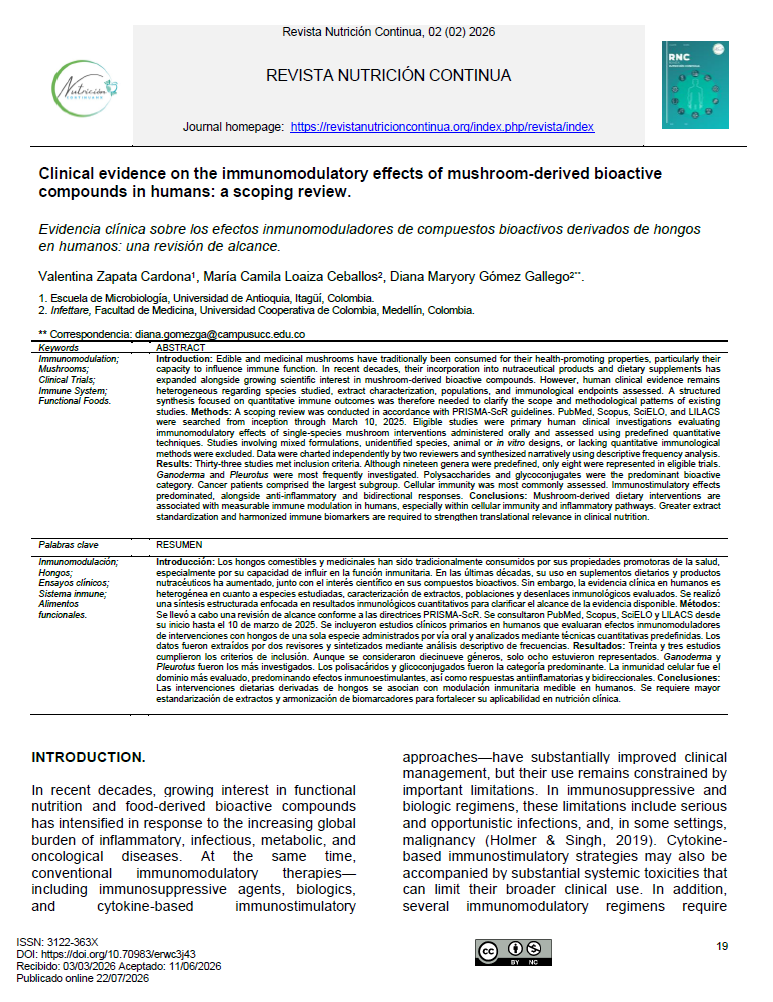
Evidencia clínica sobre los efectos inmunomoduladores de compuestos bioactivos derivados de hongos en humanos: una revisión de alcance
DOI:
https://doi.org/10.70983/erwc3j43Palabras clave:
Inmnomodulación, Hongos, Ensayos clínicos, Sistema Inmune, Alimentos funcionalesResumen
Introducción: Los hongos comestibles y medicinales han sido tradicionalmente consumidos por sus propiedades promotoras de la salud, especialmente por su capacidad de influir en la función inmunitaria. En las últimas décadas, su uso en suplementos dietarios y productos nutracéuticos ha aumentado, junto con el interés científico en sus compuestos bioactivos. Sin embargo, la evidencia clínica en humanos es heterogénea en cuanto a especies estudiadas, caracterización de extractos, poblaciones y desenlaces inmunológicos evaluados. Se realizó una síntesis estructurada enfocada en resultados inmunológicos cuantitativos para clarificar el alcance de la evidencia disponible. Métodos: Se llevó a cabo una revisión de alcance conforme a las directrices PRISMA-ScR. Se consultaron PubMed, Scopus, SciELO y LILACS desde su inicio hasta el 10 de marzo de 2025. Se incluyeron estudios clínicos primarios en humanos que evaluaran efectos inmunomoduladores de intervenciones con hongos de una sola especie administrados por vía oral y analizados mediante técnicas cuantitativas predefinidas. Los datos fueron extraídos por dos revisores y sintetizados mediante análisis descriptivo de frecuencias. Resultados: Treinta y tres estudios cumplieron los criterios de inclusión. Aunque se consideraron diecinueve géneros, solo ocho estuvieron representados. Ganoderma y Pleurotus fueron los más investigados. Los polisacáridos y glicoconjugados fueron la categoría predominante. La inmunidad celular fue el dominio más evaluado, predominando efectos inmunoestimulantes, así como respuestas antiinflamatorias y bidireccionales. Conclusiones: Las intervenciones dietarias derivadas de hongos se asocian con modulación inmunitaria medible en humanos. Se requiere mayor estandarización de extractos y armonización de biomarcadores para fortalecer su aplicabilidad en nutrición clínica.
Referencias
Al-jumaili, M. M. O., Al-dulaimi, F. K. Y., & Ajeel, M. A. (2020). The Role of Ganoderma lucidum Uptake on Some Hematological and Immunological Response in Patients with Coronavirus (COVID-19). Systematic Reviews in Pharmacy, 11(8), 537–541. https://doi.org/10.31838/srp.2020.8.76
Aryanugraha, T., Sargowo, D., & Rahimah, A. F. (2024). Effect of Î2-1,3-1,6-D-glukan (polysaccharide peptide) from miselia Ganoderma lucidum extract as antioxidant and antiinflammation towards left ventricular systolic function in cardiometabolic patients. Heart Science Journal, 5(4), 55–59. https://doi.org/10.21776/ub.hsj.2024.005.04.9
Ayeka, P. A. (2018). Potential of Mushroom Compounds as Immunomodulators in Cancer Immunotherapy: A Review. Evidence-Based Complementary and Alternative Medicine, 2018(1), 7271509. https://doi.org/10.1155/2018/7271509
Baumgart, D. C., Misery, L., Naeyaert, S., & Taylor, P. C. (2019). Biological Therapies in Immune-Mediated Inflammatory Diseases: Can Biosimilars Reduce Access Inequities? Frontiers in Pharmacology, 10. https://doi.org/10.3389/fphar.2019.00279
Bergendiova, K., Tibenska, E., & Majtan, J. (2011). Pleuran (β-glucan from Pleurotus ostreatus) supplementation, cellular immune response and respiratory tract infections in athletes. European Journal of Applied Physiology, 111(9), 2033–2040. https://doi.org/10.1007/s00421-011-1837-z
Bobovčák, M., Kuniaková, R., Gabriž, J., & Majtán, J. (2010). Effect of Pleuran (β-glucan from Pleurotus ostreatus) supplementation on cellular immune response after intensive exercise in elite athletes. Applied Physiology, Nutrition, and Metabolism, 35(6), 755–762. https://doi.org/10.1139/H10-070
Brown, G. D., & Gordon, S. (2005). Immune recognition of fungal β-glucans. Cellular Microbiology, 7(4), 471–479. https://doi.org/10.1111/j.1462-5822.2005.00505.x
Chan, G. C.-F., Chan, W. K., & Sze, D. M.-Y. (2009). The effects of β-glucan on human immune and cancer cells. Journal of Hematology & Oncology, 2(1), 25. https://doi.org/10.1186/1756-8722-2-25
Chen, S.-N., Nan, F.-H., Liu, M.-W., Yang, M.-F., Chang, Y.-C., & Chen, S. (2023). Evaluation of Immune Modulation by β-1,3; 1,6 D-Glucan Derived from Ganoderma lucidum in Healthy Adult Volunteers, A Randomized Controlled Trial. Foods, 12(3). https://doi.org/10.3390/foods12030659
Chu, T. T. W., Benzie, I. F. F., Lam, C. W. K., Fok, B. S. P., Lee, K. K. C., & Tomlinson, B. (2012). Study of potential cardioprotective effects of Ganoderma lucidum (Lingzhi): Results of a controlled human intervention trial. British Journal of Nutrition, 107(7), 1017–1027. https://doi.org/10.1017/S0007114511003795
Chugh, R. M., Mittal, P., Mp, N., Arora, T., Bhattacharya, T., Chopra, H., Cavalu, S., & Gautam, R. K. (2022). Fungal Mushrooms: A Natural Compound With Therapeutic Applications. Frontiers in Pharmacology, 13. https://doi.org/10.3389/fphar.2022.925387
Costa Fortes, R., & Carvalho Garbi Novaes, M. a R. (2011). Efectos de la suplementación dietética con hongos Agaricus sylvaticus en el metabolismo y la presión arterial en pacientes con cáncer colorrectal en la fase postoperatoria. Nutrición Hospitalaria, 26(1), 176–186. https://scielo.isciii.es/scielo.php?script=sci_abstract&pid=S0212-16112011000100021&lng=es&nrm=iso&tlng=en
Deng, G., Lin, H., Seidman, A., Fornier, M., D’Andrea, G., Wesa, K., Yeung, S., Cunningham-Rundles, S., Vickers, A. J., & Cassileth, B. (2009). A phase I/II trial of a polysaccharide extract from Grifola frondosa (Maitake mushroom) in breast cancer patients: Immunological effects. Journal of Cancer Research and Clinical Oncology, 135(9), 1215–1221. https://doi.org/10.1007/s00432-009-0562-z
Deng, Y., Ma, J., Tang, D., & Zhang, Q. (2021). Dynamic biomarkers indicate the immunological benefits provided by Ganoderma spore powder in post-operative breast and lung cancer patients. Clinical and Translational Oncology, 23(7), 1481–1490. https://doi.org/10.1007/s12094-020-02547-9
Dündar, A., Yalçın, P., Arslan, N., Acay, H., Hatipoğlu, A., Boğa, M., Karahan, S., & Yaprak, B. (2024). Effect of Pleurotus ostreatus Water Extract Consumption on Blood Parameters and Cytokine Values in Healthy Volunteers. Journal of the American Nutrition Association, 43(8), 645–652. https://doi.org/10.1080/27697061.2024.2369781
Fortes, R. C., Novaes, M. R. C. G., Recôva, V. L., & Melo, A. L. (2009). Immunological, Hematological, and Glycemia Effects of Dietary Supplementation with Agaricus sylvaticus on Patients’ Colorectal Cancer. Experimental Biology and Medicine, 234(1), 53–62. https://doi.org/10.3181/0806-RM-193
Gao, Y., Tang, W., Dai, X., Gao, H., Chen, G., Ye, J., Chan, E., Koh, H. L., Li, X., & Zhou, S. (2005). Effects of Water-Soluble Ganoderma lucidum Polysaccharides on the Immune Functions of Patients with Advanced Lung Cancer. Journal of Medicinal Food, 8(2), 159–168. https://doi.org/10.1089/jmf.2005.8.159
Gao, Y., Zhou, S., Jiang, W., Huang, M., & Dai, X. (2003). Effects of Ganopoly® (A Ganoderma lucidum Polysaccharide Extract) on the Immune Functions in Advanced‐Stage Cancer Patients. Immunological Investigations, 32(3), 201–215. https://doi.org/10.1081/IMM-120022979
Gaullier, J.-M., Sleboda, J., Ofjord, E. S., Ulvestad, E., Nurminiemi, M., Moe, C., Albrektsen, T., & Gudmundsen, O. (2011). Supplementation with a Soluble Beta-Glucan Exported from Shiitake Medicinal Mushroom, Lentinus edodes (Berk.) Singer Mycelium: A Crossover, Placebo-Controlled Study in Healthy Elderly. International Journal of Medicinal Mushrooms, 13(4). https://doi.org/10.1615/IntJMedMushr.v13.i4.10
Goodridge, H. S., Wolf, A. J., & Underhill, D. M. (2009). β-glucan recognition by the innate immune system. Immunological Reviews, 230(1), 38–50. https://doi.org/10.1111/j.1600-065X.2009.00793.x
Hashemi Yusefabad, H., Hosseini, S. A., Zakerkish, M., Cheraghian, B., & Alipour, M. (2022). The effects of hot air-dried white button mushroom powder on glycemic indices, lipid profile, inflammatory biomarkers and total antioxidant capacity in patients with type-2 diabetes mellitus: A randomized controlled trial. Journal of Research in Medical Sciences: The Official Journal of Isfahan University of Medical Sciences, 27, 49. https://doi.org/10.4103/jrms.JRMS_513_20
He, T., Zhao, R., Lu, Y., Li, W., Hou, X., Sun, Y., Dong, M., & Chen, L. (2016). Dual-Directional Immunomodulatory Effects of Corbrin Capsule on Autoimmune Thyroid Diseases. Evidence-Based Complementary and Alternative Medicine, 2016(1), 1360386. https://doi.org/10.1155/2016/1360386
Henao, S. L. D., Urrego, S. A., Cano, A. M., & Higuita, E. A. (2018). Randomized Clinical Trial for the Evaluation of Immune Modulation by Yogurt Enriched with β-Glucans from Lingzhi or Reishi Medicinal Mushroom, Ganoderma lucidum (Agaricomycetes), in Children from Medellin, Colombia. International Journal of Medicinal Mushrooms, 20(8). https://doi.org/10.1615/IntJMedMushrooms.2018026986
https://www.polarismarketresearch.com, P. M. R. (2025). Mushroom Market Size 2025. Polaris Market Research. https://www.polarismarketresearch.com/industry-analysis/mushroom-market
Holmer, A., & Singh, S. (2019). Overall and comparative safety of biologic and immunosuppressive therapy in inflammatory bowel diseases. Expert Review of Clinical Immunology, 15(9), 969–979. https://doi.org/10.1080/1744666X.2019.1646127
Jesenak, M., Hrubisko, M., Majtan, J., Rennerova, Z., & Banovcin, P. (2014). Anti-allergic Effect of Pleuran (β-glucan from Pleurotus ostreatus) in Children with Recurrent Respiratory Tract Infections. Phytotherapy Research, 28(3), 471–474. https://doi.org/10.1002/ptr.5020
Jesenak, M., Majtan, J., Rennerova, Z., Kyselovic, J., Banovcin, P., & Hrubisko, M. (2013). Immunomodulatory effect of pleuran (β-glucan from Pleurotus ostreatus) in children with recurrent respiratory tract infections. International Immunopharmacology, 15(2), 395–399. https://doi.org/10.1016/j.intimp.2012.11.020
Kang, H. J., Baik, H. W., Kim, S. J., Lee, S. G., Ahn, H. Y., Park, J. S., Park, S. J., Jang, E. J., Park, S. W., Choi, J. Y., Sung, J. H., & Lee, S. M. (2015). Cordyceps militaris Enhances Cell-Mediated Immunity in Healthy Korean Men. Journal of Medicinal Food, 18(10), 1164–1172. https://doi.org/10.1089/jmf.2014.3350
Kodama, N., Komuta, K., Sakai, N., & Nanba, H. (2002). Effects of D-Fraction, a Polysaccharide from Grifola frondosa on Tumor Growth Involve Activation of NK Cells. Biological and Pharmaceutical Bulletin, 25(12), 1647–1650. https://doi.org/10.1248/bpb.25.1647
Ku, Y. H., & Kang, J. H. (2022). Efficacy of Phellinus linteus extract on immunity enhancement: A CONSORT-randomized, double-blind, placebo-controlled pilot trial. Medicine, 101(40), e30829. https://doi.org/10.1097/MD.0000000000030829
Ku, Y. H., Kang, J. H., & Lee, H. (2022). Effects of Phellinus linteus extract on immunity improvement: A CONSORT-randomized, double-blinded, placebo-controlled trial. Medicine, 101(34), e30226. https://doi.org/10.1097/MD.0000000000030226
Lee, J.-B., Shin, Y.-O., Bae, J.-S., Min, Y.-K., Yang, H.-M., Seo, H.-S., Kwon, D., Kang, J., & Song, Y. (2010). Effect of Phellinus linteus extract supplementation on cortisol and related cytokines in young male adults. Food Science and Biotechnology, 19(3), 671–675. https://doi.org/10.1007/s10068-010-0094-y
Li, E. K., Tam, L.-S., Wong, C. K., Li, W. C., Lam, C. W. K., Wachtel-Galor, S., Benzie, I. F. F., Bao, Y. X., Leung, P. C., & Tomlinson, B. (2007). Safety and efficacy of Ganoderma lucidum (lingzhi) and San Miao San supplementation in patients with rheumatoid arthritis: A double-blind, randomized, placebo-controlled pilot trial. Arthritis Care & Research, 57(7), 1143–1150. https://doi.org/10.1002/art.22994
Loaiza-Ceballos, M. C., Rendon-Marin, S., Higuita-Gutiérrez, L. F., Hernandez, J. C., & Gómez-Gallego, D. M. (2025). Immunomodulatory effects of functional fungi and their bioactive components: A scoping review of preclinical studies. Phytomedicine Plus, 5(4), 100881. https://doi.org/10.1016/j.phyplu.2025.100881
Łysakowska, P., Sobota, A., & Wirkijowska, A. (2023). Medicinal Mushrooms: Their Bioactive Components, Nutritional Value and Application in Functional Food Production—A Review. Molecules, 28(14). https://doi.org/10.3390/molecules28145393
Lull, C., Wichers, H. J., & Savelkoul, H. F. J. (2005). Antiinflammatory and Immunomodulating Properties of Fungal Metabolites. Mediators of Inflammation, 2005(2), 892572. https://doi.org/10.1155/MI.2005.63
Miyazaki, K., Mizutani, H., Katabuchi, H., Fukuma, K., Fujisaka, S., & Okamura, H. (1995). Activated (HLA-DR+) T-Lymphocyte Subsets in Cervical Carcinoma and Effects of Radiotherapy and Immunotherapy with Sizofiran on Cell-Mediated Immunity and Survival. Gynecologic Oncology, 56(3), 412–420. https://doi.org/10.1006/gyno.1995.1073
Nanba, H., Kodama, N., Schar, D., & Turner, D. (2000). Effects of Maitake (Grifola frondosa) glucan in HIV-infected patients. Mycoscience, 41(4), 293–295. https://doi.org/10.1007/BF02463941
Netea, M. G., Joosten, L. A. B., Latz, E., Mills, K. H. G., Natoli, G., Stunnenberg, H. G., O’Neill, L. A. J., & Xavier, R. J. (2016). Trained immunity: A program of innate immune memory in health and disease. Science (New York, N.Y.), 352(6284), aaf1098. https://doi.org/10.1126/science.aaf1098
Ontawong, A., Pengnet, S., Thim-Uam, A., Munkong, N., Narkprasom, N., Narkprasom, K., Kuntakhut, K., Kamkeaw, N., & Amornlerdpison, D. (2024). A randomized controlled clinical trial examining the effects of Cordyceps militaris beverage on the immune response in healthy adults. Scientific Reports, 14(1), 7994. https://doi.org/10.1038/s41598-024-58742-z
Poedjomartono, B., Faisal, A., & Nurjanah, S. (2020). Transarterial Chemoembolization in Hepatocellular Carcinoma: A Clinical Efficacy Study of Ganoderma lucidum Extract Polysaccharide Peptide β-Glucan. Bali Medical Journal, 9(1), 31–35. https://doi.org/10.15562/bmj.v9i1.1610
Rigby, W. F. C., Lampl, K., Low, J. M., & Furst, D. E. (2017). Review of Routine Laboratory Monitoring for Patients with Rheumatoid Arthritis Receiving Biologic or Nonbiologic DMARDs. International Journal of Rheumatology, 2017, 9614241. https://doi.org/10.1155/2017/9614241
Tanaka, A., Nishimura, M., Sato, Y., Sato, H., & Nishihira, J. (2016). Enhancement of the Th1-phenotype immune system by the intake of Oyster mushroom (Tamogitake) extract in a double-blind, placebo-controlled study. Journal of Traditional and Complementary Medicine, 6(4), 424–430. https://doi.org/10.1016/j.jtcme.2015.11.004
Tangkhaphiphat, P., Siritientong, T., Jaruhathai, S., Pipopchaiyasit, N., Ratanajarusiri, T., & Aramwit, P. (2022). Immunomodulatory efficacy and safety of Ganoderma lucidum broken spore supplement in patients after chemotherapy. Science, Engineering and Health Studies, 22050017–22050017. https://doi.org/10.14456/sehs.2022.41
Tricco, A. C., Lillie, E., Zarin, W., O’Brien, K. K., Colquhoun, H., Levac, D., Moher, D., Peters, M. D. J., Horsley, T., Weeks, L., Hempel, S., Akl, E. A., Chang, C., McGowan, J., Stewart, L., Hartling, L., Aldcroft, A., Wilson, M. G., Garritty, C., … Straus, S. E. (2018). PRISMA Extension for Scoping Reviews (PRISMA-ScR): Checklist and Explanation. Annals of Internal Medicine, 169(7), 467–473. https://doi.org/10.7326/M18-0850
Venturella, G., Ferraro, V., Cirlincione, F., & Gargano, M. L. (2021). Medicinal Mushrooms: Bioactive Compounds, Use, and Clinical Trials. International Journal of Molecular Sciences, 22(2). https://doi.org/10.3390/ijms22020634
Volman, J. J., Mensink, R. P., van Griensven, L. J. L. D., & Plat, J. (2010). Effects of α-glucans from Agaricus bisporus on ex vivo cytokine production by LPS and PHA-stimulated PBMCs; a placebo-controlled study in slightly hypercholesterolemic subjects. European Journal of Clinical Nutrition, 64(7), 720–726. https://doi.org/10.1038/ejcn.2010.32
Wasser, S. P. (2011). Current findings, future trends, and unsolved problems in studies of medicinal mushrooms. Applied Microbiology and Biotechnology, 89(5), 1323–1332. https://doi.org/10.1007/s00253-010-3067-4
Wesa, K. M., Cunningham-Rundles, S., Klimek, V. M., Vertosick, E., Coleton, M. I., Yeung, K. S., Lin, H., Nimer, S., & Cassileth, B. R. (2015). Maitake mushroom extract in myelodysplastic syndromes (MDS): A phase II study. Cancer Immunology, Immunotherapy, 64(2), 237–247. https://doi.org/10.1007/s00262-014-1628-6
Yadav, D., & Negi, P. S. (2021). Bioactive components of mushrooms: Processing effects and health benefits. Food Research International, 148, 110599. https://doi.org/10.1016/j.foodres.2021.110599
Zembron-Lacny, A., Gajewski, M., Naczk, M., & Siatkowski, I. (2013). Effect of shiitake (Lentinus edodes) extract on antioxidant and inflammatory response to prolonged eccentric exercise. Journal of Physiology and Pharmacology: An Official Journal of the Polish Physiological Society, 64(2), 249–254.
Zhao, H., Zhang, Q., Zhao, L., Huang, X., Wang, J., & Kang, X. (2012). Spore Powder of Ganoderma lucidum Improves Cancer-Related Fatigue in Breast Cancer Patients Undergoing Endocrine Therapy: A Pilot Clinical Trial. Evidence-Based Complementary and Alternative Medicine, 2012(1), 809614. https://doi.org/10.1155/2012/809614
Descargas
Publicado
Número
Sección
Licencia
Derechos de autor 2026 Valentina Zapata-Cardona, Maria Camila Loaiza-Ceballos, Diana Maryory Gómez-Gallego (Autor/a)

Esta obra está bajo una licencia internacional Creative Commons Atribución-NoComercial 4.0.